
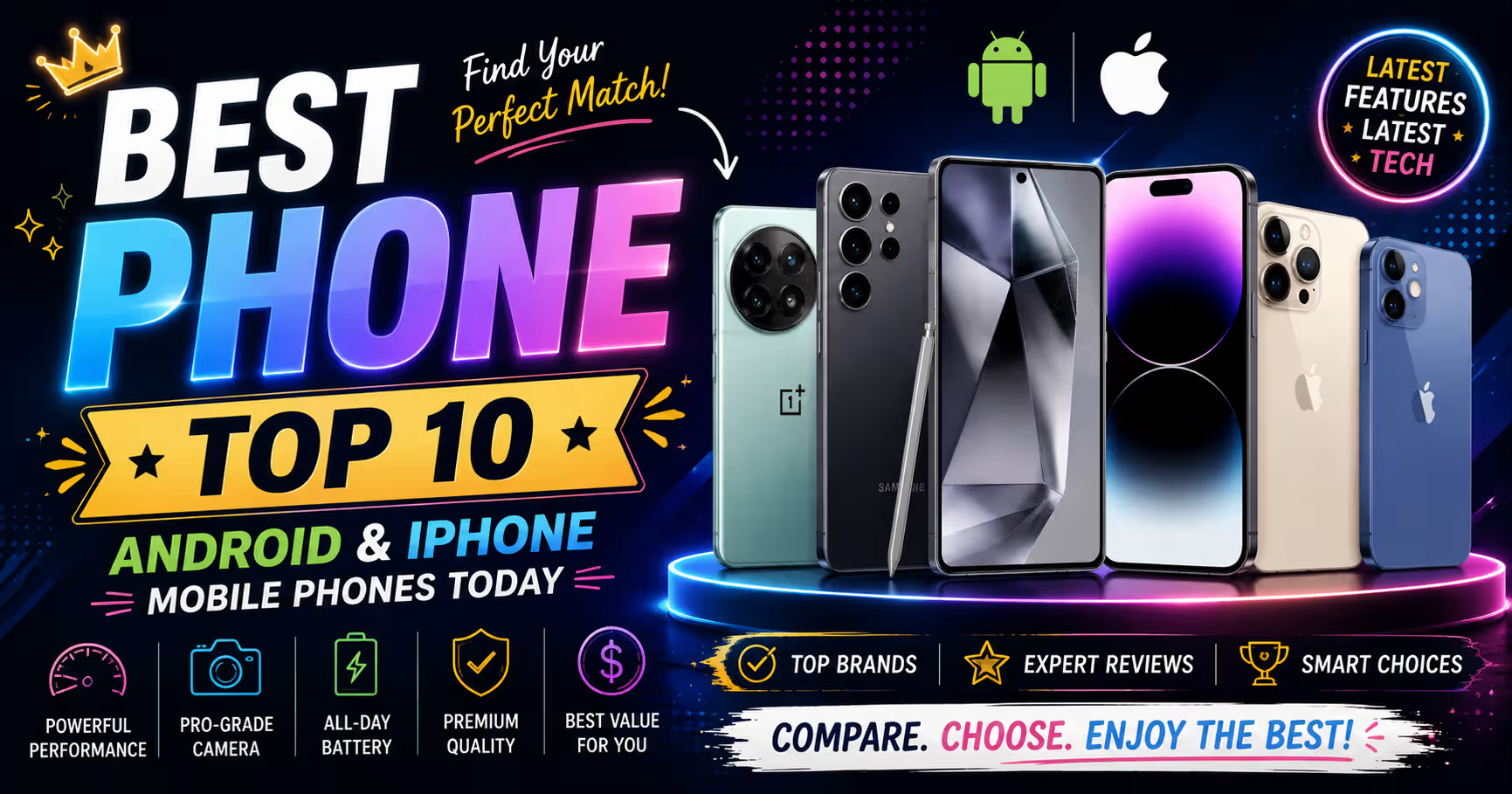
Best Phone 2026: Top 10 Android & iPhone Mobile Phones Today
Buying a new phone is one of those decisions that quietly shapes your everyday life. It’s the device that wakes you up, holds your banking apps, stores thousands of photos of the people you love, and somehow still needs to survive being dropped, drained, and dunked in a puddle at least once before you upgrade again. With that much riding on a single purchase, it pays to get it right.
2026 has turned out to be one of the most competitive years the smartphone industry has seen in a long time. Apple has settled into its boldest iPhone redesign in years, Samsung has doubled down on AI and introduced a genuinely useful privacy feature nobody else has, Google’s Pixel line has become the phone to beat for software polish, and a wave of Chinese brands — Oppo, Xiaomi, and Honor among them — are pushing camera and battery hardware further than Western brands seem willing to go. Meanwhile, foldables have finally graduated from “interesting experiment” to “phone I’d actually recommend to a friend.”
All of this choice is great news for buyers, but it also makes picking the right phone genuinely harder. Do you go all-in on the newest Pixel? Is the Galaxy S26 Ultra worth the upgrade if you already own an S25 Ultra? Is now finally the moment to try a foldable? And does anyone actually need to spend $1,300 on a phone at all?
We’ve spent weeks testing, comparing spec sheets, benchmarking, and living with the newest releases from Apple, Samsung, Google, Oppo, Motorola, and Xiaomi to build this guide. Below you’ll find our ranked list of the ten best phones you can buy right now, a breakdown of who each one is actually for, and a full buying guide to help you figure out which factors matter most for the way you actually use your phone. If your budget is tighter, we’ve also flagged the best mid-range and budget alternatives along the way.
How We Chose These Phones
Every phone on this list has been used as a genuine daily driver — not just unboxed and benchmarked for an afternoon. That means running our own SIM in the device, carrying it around for at least a week (often much longer), and putting it through the situations that actually matter: shooting photos in bad lighting, gaming on a train with patchy signal, streaming video on a flight, and watching how the battery holds up on a long, demanding day.
We combine that hands-on experience with objective benchmarking — synthetic performance tests, display brightness and color accuracy measurements, and controlled battery-drain comparisons — so that our subjective impressions are backed by comparable numbers. A phone only earns a place on this list if it excels in the categories that matter most to real users: design and build quality, display quality, performance, camera output, battery life and charging speed, software experience and update policy, and overall value for money.
We also update this guide regularly. Phones get discontinued, prices fluctuate, and new flagships arrive several times a year, so what tops this list today may shift as soon as next quarter. We’ll flag upcoming launches that could shake up the rankings later in this article.
Quick Comparison: Top 10 Phones at a Glance
| Rank | Phone | Best For | Starting Price | Display | Battery |
|---|---|---|---|---|---|
| 1 | Google Pixel 10 Pro XL | Best phone overall | $1,199 | 6.8″ LTPO OLED | ~5,200mAh |
| 2 | Samsung Galaxy S26 Ultra | Best Android software & AI | $1,299 | 6.9″ AMOLED | ~5,000mAh |
| 3 | Oppo Find X9 Ultra | Best camera phone | ~$1,300 (import) | 6.82″ 144Hz AMOLED | 7,050mAh |
| 4 | Apple iPhone 17 | Best iPhone for most people | $799 | 6.3″ OLED | ~3,700mAh |
| 5 | Apple iPhone 17 Pro Max | Best premium iPhone | $1,199 | 6.9″ OLED | ~5,000mAh |
| 6 | Motorola Razr Fold | Best foldable | $1,899 | Dual OLED | 6,000mAh |
| 7 | Samsung Galaxy Z Fold 8 | Best book-style foldable | $1,899 | 5.5″ cover / 7.6″ inner | ~4,900mAh |
| 8 | Samsung Galaxy S25 FE | Best mid-range phone | $649 | 6.7″ AMOLED | ~4,900mAh |
| 9 | Xiaomi 17 | Best compact flagship | ~$900 (import) | 6.3″ LTPO OLED | 6,330mAh |
| 10 | Nothing Phone (3a) | Best budget phone | ~$379 | 6.77″ AMOLED | 5,000mAh |
The 10 Best Phones You Can Buy in 2026
1. Google Pixel 10 Pro XL – Best Phone Overall
If price genuinely isn’t a barrier, the Pixel 10 Pro XL is the phone we’d recommend before any other. It’s the rare device that doesn’t really have a glaring weakness — hardware and software both feel fully resolved, and that combination is difficult to find anywhere else on this list.
The design is understated but classy, and the 6.8-inch display is one of the best panels on the market: bright, color-accurate, and smooth at up to 120Hz. Build quality feels genuinely premium, and Google has stuck with IP68 water and dust resistance, so durability isn’t a concern either.
Photography is where the Pixel 10 Pro XL really separates itself. Google’s computational photography pipeline remains the benchmark for point-and-shoot results — you can hand this phone to almost anyone and they’ll come away with excellent photos without touching a manual setting. Low-light performance, portrait mode, and video capture are all excellent, though the headline 100x “Pro Res Zoom” feature is more of a gimmick than a genuinely useful tool; results at extreme zoom levels are often soft and over-processed.
Charging has finally caught up to the rest of the phone, too. This is the first Pixel to support Qi2 wireless charging natively, opening the door to Google’s new “Pixelsnap” magnetic accessory ecosystem, alongside improved 45W wired charging. Battery life across a full day of moderate-to-heavy use is comfortably solid, if not class-leading.
Software is where the Pixel 10 Pro XL pulls furthest ahead of the competition. It’s among the very first phones to run Android 17, and Google has committed to software and security updates all the way out to 2032 — a support window that rivals even Samsung and Apple. Combined with genuinely useful AI features (rather than gimmicky ones bolted on for marketing), the Pixel’s software experience remains unmatched on Android.
Pros:
- Gorgeous design and display
- Best-in-class computational photography
- Long-term software support to 2032
- Native Qi2 wireless charging
Cons:
- Large and heavy for one-handed use
- 100x zoom is more marketing than substance
- One of the pricier phones on this list
Who should buy it: Anyone who wants the single best phone available today, doesn’t mind paying a premium, and is comfortable using Android. If you want something more pocketable, the standard Pixel 10 Pro or Pixel 10 offer a near-identical experience in a smaller frame.
2. Samsung Galaxy S26 Ultra – Best Android Software & AI
Samsung’s flagship has always been the phone for people who want everything — a stylus, a huge screen, a versatile camera array, and software packed with features. The Galaxy S26 Ultra continues that tradition, and while the year-on-year upgrades are relatively modest, it remains one of the very best Android phones you can buy.
The star of the show is a genuinely new feature: Privacy Display. This clever bit of screen technology can selectively black out sensitive information — banking apps, private messages, anything you don’t want a stranger on the train glancing at — either across the whole display or in specific zones. It sounds like a small addition, but in daily use it’s the kind of feature you start to miss on every other phone once you’ve tried it.
The 6.9-inch AMOLED panel remains one of the most immersive displays around, and paired with the phone’s stereo speakers, it makes the S26 Ultra a genuine pocket entertainment hub for streaming. Charging has also improved, now topping out at 60W wired and 25W wireless — noticeably faster than before, even if Samsung still hasn’t added Qi2 magnetic charging, which puts it a step behind the Pixel and iPhone in that one respect.
Under the hood, a Snapdragon 8 Elite Gen 5 chip tuned specifically for Galaxy hardware delivers excellent performance across gaming, multitasking, and — crucially — Samsung’s suite of Galaxy AI tools, which continue to be some of the most capable AI features on any Android phone. One UI itself has matured into slick, intuitive software, and even Bixby has become genuinely useful for the first time in years.
The built-in S-Pen remains a differentiator no other flagship offers, though its storage position inside the chassis continues to feel like an afterthought in terms of ergonomics.
Pros:
- Class-leading Galaxy AI features
- Exclusive Privacy Display technology
- Gorgeous 6.9-inch display with excellent speakers
- Faster 60W wired charging
Cons:
- Iterative upgrade over the S25 Ultra
- No Qi2 magnetic wireless charging
- S-Pen placement remains awkward
- Expensive, and got pricier this generation
Who should buy it: Android power users who want the most complete flagship experience, particularly anyone who values AI tools, a built-in stylus, or the new Privacy Display for handling sensitive information on the go. Budget-conscious buyers should look at the standard Galaxy S26 or S26+, which share the same core experience for less.
3. Oppo Find X9 Ultra – Best Camera Phone
If photography is your single biggest priority, the Oppo Find X9 Ultra is difficult to beat — and in our testing, it’s arguably the best camera phone released this year, full stop. It isn’t officially sold in the US, but it’s worth importing if photography is what drives your buying decision, and it’s widely available across the UK, Europe, and Asia.
The Find X9 Ultra’s multi-lens rear array, built around large sensors and Hasselblad-tuned color science, produces stunning results across almost every lighting scenario — bright daylight, tricky mixed indoor lighting, and genuinely impressive low-light and night shots. Detail retention, dynamic range, and color accuracy are all excellent, and the phone handles telephoto and ultrawide shooting with a consistency that few rivals match.
It isn’t a one-trick pony, either. The 6.82-inch, 144Hz AMOLED display is one of the best screens available on any phone this year, and the 7,050mAh silicon-carbon battery — paired with 100W wired and 50W wireless charging — delivers genuine multi-day battery life for most users, a rarity among flagship-tier phones. A Snapdragon 8 Elite Gen 5 chip keeps performance near the top of the class, though the phone can run noticeably warm under sustained load, such as extended gaming sessions.
The main drawbacks are availability and price. Because it isn’t officially sold in some regions, buyers may need to import the phone and forgo full carrier and warranty support. At its price point, it also competes directly with the very best from Samsung, Apple, and Google — so you’re paying flagship money without the benefit of a familiar ecosystem, unless you’re already invested in Oppo or its sibling brand OnePlus.
Pros:
- Outstanding cameras across every scenario
- Huge 7,050mAh battery with fast wired and wireless charging
- Excellent 144Hz display
- Smooth, powerful performance
Cons:
- Very expensive
- Runs hot under heavy load
- Limited official availability outside select markets
- Camera button placement takes getting used to
Who should buy it: Photography enthusiasts who want the single best camera experience money can buy and don’t mind importing a phone or stepping outside the more familiar Samsung/Google/Apple ecosystem.
4. Apple iPhone 17 – Best iPhone for Most People
Apple shook up its lineup significantly with the introduction of the ultra-thin iPhone Air and a bolder redesign for the Pro models, which makes choosing an iPhone less straightforward than it used to be. Cutting through that complexity, the standard iPhone 17 remains the smartest pick for the vast majority of buyers.
It delivers everything most people actually want from a modern iPhone: a vivid, smooth OLED display, a compact and comfortable design, dependable day-to-day performance, and cameras that reliably produce great photos and videos for social media and everyday memories, without requiring any manual fiddling. Storage has also doubled at the base tier compared to the previous generation, meaning you’re no longer forced into a pricier model just to get usable space for photos and apps.
Battery life is solid across a typical day, and — provided you use the right charging adapter — charging speeds have also improved this generation. If you’re upgrading from an iPhone 14 or earlier, the difference will feel substantial; if you’re coming from an iPhone 15 or 16, you likely won’t feel a pressing need to upgrade just yet.
Where the iPhone 17 shows its limits is with Apple Intelligence, which is still finding its footing compared to the AI feature sets on rival Android flagships, and some more advanced camera and display features remain exclusive to the pricier Pro models. The Camera Control button, introduced in previous generations, also still feels like a work in progress.
Even so, as an all-rounder that balances price, performance, and everyday usability, the iPhone 17 is the iPhone to buy unless you have a specific reason to spend more — or less.
Pros:
- Excellent value relative to Pro models
- Vivid, smooth display
- Double the base storage over last year
- Reliable battery life with faster charging support
Cons:
- Apple Intelligence is still maturing
- Camera lacks a telephoto lens, unlike some similarly priced Android rivals
- Camera Control button needs refinement
Who should buy it: Anyone who wants the best value from Apple’s current iPhone lineup without stepping up to Pro-level pricing. Budget-focused buyers should also consider the cheaper iPhone 17e, which trims some features to hit a lower price point.
5. Apple iPhone 17 Pro Max – Best Premium iPhone
For buyers who want the absolute best iPhone experience Apple currently offers, and who don’t mind paying for it, the iPhone 17 Pro Max delivers a genuinely no-compromise flagship.
This is a big phone in every sense — a 6.9-inch display housed in a redesigned chassis that includes a more prominent camera plateau, a design choice that has proven divisive among longtime iPhone owners. Whatever you make of the aesthetics, the hardware underneath is exceptional: top-tier performance thanks to Apple’s latest silicon, superb build quality, and a camera system that can go toe-to-toe with the best Android flagships in nearly every scenario, from portraits to low-light photography to cinematic video capture.
Battery life is among the best Apple has ever shipped in an iPhone, comfortably lasting a full day of heavy use, and iOS 26 brings the most customizable, visually refined version of iOS to date. Apple’s commitment to fast, long-running software updates also remains a genuine advantage — iPhones routinely receive major OS updates for five-plus years, with security patches extending even further.
The trade-offs are largely what you’d expect from any “ultimate” flagship: it’s expensive, it’s heavy, and the redesigned camera housing won’t appeal to everyone. If you don’t need the absolute largest screen or the most advanced camera hardware Apple offers, the standard iPhone 17 will save you a significant amount of money while covering most of the same day-to-day bases.
Pros:
- Outstanding display and build quality
- Best-in-class iPhone camera system
- Excellent battery life
- Long, reliable software support
Cons:
- Divisive redesign
- Expensive, especially at higher storage tiers
- Large and heavy in the hand
Who should buy it: iPhone loyalists who want the most complete, premium experience Apple currently sells and are willing to pay a significant premium for it.
6. Motorola Razr Fold – Best Foldable
Motorola has quietly built one of the best flip-phone lineups in the industry, and its first serious attempt at a book-style foldable, the Razr Fold, is a genuine surprise hit — arguably outclassing rivals from both Samsung and Honor in key areas.
The design is the first thing that stands out. Where many foldables lean toward a slightly clinical, utilitarian look, the Razr Fold carries Motorola’s flair for color and texture, with finishes like the Pantone Lily White variant standing out from an increasingly homogenous foldable market. The grippy back panel also makes the phone feel more secure in hand than most large-screen foldables manage.
Camera performance punches well above what you’d expect from a first-generation foldable in this category, borrowing computational photography techniques from Motorola’s other recent flagships. The triple 50MP rear sensor setup produces vibrant, well-exposed daytime shots and holds up impressively in low light too.
Battery life is a genuine highlight: a 6,000mAh cell — larger than what you’ll find in most rival foldables — comfortably outlasts Samsung’s equivalent, and 80W wired plus 50W wireless charging make topping up quick and painless. Software is relatively clean once you strip away some pre-installed bloatware, though Motorola’s own AI suite lags well behind Google’s and Samsung’s offerings and is arguably better ignored in favor of built-in Gemini features.
Pros:
- Distinctive, tactile design
- Strong camera performance for the category
- Class-leading 6,000mAh battery with fast charging
- Big, bright displays inside and out
Cons:
- Relatively bulky compared to some rivals
- Stylus integration could be smoother
- Performance isn’t quite cutting-edge
Who should buy it: Foldable shoppers who want strong all-around specs — especially camera quality and battery life — over the absolute latest chipset performance.
7. Samsung Galaxy Z Fold 8 – Best Book-Style Foldable
Samsung’s foldable lineup has expanded this year to include a more traditional “Ultra” successor to the Z Fold 7 alongside this new, squarer-format Z Fold 8 — and it might be the more interesting device of the two.
Closed, the Z Fold 8’s 5.5-inch, 16:10 cover display is compact and genuinely easy to use one-handed, harking back to smaller phones of years past. It’s ideal for quickly firing off messages or framing a photo. Unfold it, though, and you’re greeted by a 7.6-inch inner display with a boxier aspect ratio that’s noticeably better suited to widescreen movies, TV shows, and games than the taller, narrower panels found in most rival foldables — content simply has more room to breathe without heavy letterboxing.
That extra screen real estate also makes the Z Fold 8 an excellent portable gaming device, especially when paired with a Bluetooth controller and the phone’s built-in kickstand. Software benefits from years of Samsung foldable refinement, with One UI’s multitasking tools — split-screen apps, drag-and-drop, and a taskbar reminiscent of a desktop OS — feeling genuinely more mature here than what Honor or Motorola currently offer.
The most notable compromise is the camera system: at this price, a two-lens rear setup without a dedicated telephoto lens feels like a missed opportunity, especially given how far foldable camera hardware has come elsewhere on this list.
Pros:
- Compact, pocketable form factor when folded
- Excellent 4:3-style inner screen for video and gaming
- Strong battery life and fast charging
- Mature multitasking software
Cons:
- No telephoto camera
- Software still has rough edges in places
- Gaming performance trails dedicated gaming phones
Who should buy it: Anyone who wants a foldable that doubles as a genuine portable entertainment hub for streaming and gaming, in a shape that’s still comfortable to carry day-to-day.
8. Samsung Galaxy S25 FE – Best Mid-Range Phone
Not everyone needs — or wants — to spend flagship money on a phone, and the Galaxy S25 FE remains the best all-around option if your budget tops out around $650–$700.
Samsung has done an impressive job making the FE feel like a genuine flagship rather than a watered-down budget model. The build quality and 6.7-inch display are nearly indistinguishable from the pricier Galaxy S25+, and you get the same excellent main and selfie cameras as that more expensive sibling. Performance is more than capable for everyday use, gaming, and multitasking, and 45W charging matches what you’d get on the S25 Ultra.
What really sets the S25 FE apart from rival mid-rangers, though, is software. One UI 8 brings nearly all of Samsung’s flagship-level polish and AI features down to this price tier, and Samsung’s commitment to software updates through 2032 gives it remarkable longevity for a phone at this price point — a genuine rarity in the mid-range segment, where support windows are typically much shorter.
The compromises are modest: supporting camera lenses (ultrawide and telephoto) don’t match the main sensor’s quality, and while everyday performance is strong, this isn’t the phone for the most demanding mobile games.
Pros:
- Flagship-level design and main camera
- Long software support window (through 2032)
- Strong battery life and 45W charging
- Slick, feature-rich One UI experience
Cons:
- Supporting cameras are noticeably weaker than the main sensor
- Occasional software bugs reported
- Not ideal for the most demanding games
Who should buy it: Buyers who want the closest thing to a genuine flagship experience without flagship pricing, particularly if display quality and long-term software support matter to you. The Pixel 9a is worth cross-shopping if AI features and a smaller design are higher priorities.
9. Xiaomi 17 – Best Compact Flagship
Compact phones have become an endangered species, with most manufacturers chasing bigger and bigger screens. For anyone who still wants genuine flagship performance in a size you can comfortably use one-handed, the Xiaomi 17 is the current benchmark.
At 6.3 inches, the display is noticeably easier to reach across than the 6.7-inch-plus panels found on most of this list, without sacrificing much in terms of quality — you still get a sharp 1.5K resolution, a smooth 120Hz LTPO refresh rate, and genuinely impressive peak brightness that holds up well outdoors. A Snapdragon 8 Elite Gen 5 chip delivers excellent, smooth performance for gaming and everyday multitasking alike.
Cameras are solid without being class-leading, and battery life is a genuine strength: the 6,330mAh cell — sizable even compared to some larger phones on this list — comfortably lasts a full day of heavy use, and 100W wired plus 50W wireless charging make topping up remarkably quick.
The main catch is longevity. Xiaomi currently commits to five years of OS updates, which trails the seven-plus-year windows now offered by Samsung and Google, and is worth factoring in if you plan to hold onto the phone for a long time. It’s also not officially sold in the US, so buyers there will need to import.
Pros:
- Genuine flagship performance in a compact body
- Excellent battery life relative to size
- Fast, versatile charging
- Bright, sharp display
Cons:
- Shorter software support window than Samsung or Google
- Telephoto camera performance is limited
- Not officially available in the US
Who should buy it: Compact-phone fans who refuse to compromise on performance. If you want Xiaomi’s absolute best camera hardware and don’t mind a larger footprint, the Xiaomi 17 Ultra is worth considering instead.
10. Nothing Phone (3a) – Best Budget Phone
Budget phones don’t have to look or feel cheap, and the Nothing Phone (3a) is proof of that. It’s easily the most stylish phone at its price point, and one of very few budget devices that could pass for something far more expensive at a glance.
Nothing’s signature transparent design language and the illuminated “Glyph Interface” on the back — which can indicate charging progress, notifications, and more — give the (3a) a genuinely distinctive identity that most budget Android phones simply lack. That design sensibility carries through to the software too: Nothing OS is clean, fast, and free of the bloatware and pre-installed junk apps that plague many phones in this price bracket, while offering a handful of exclusive widgets for customizing your home screen.
Battery life comfortably exceeded our expectations in testing, with the 5,000mAh cell stretching close to two full days on a single charge for moderate users — a testament to solid software optimization rather than raw battery size alone. The 50MP main and telephoto lenses also punch above their price point, producing pleasing photos in good and moderate lighting.
The clearest weak point is the 8MP ultrawide camera, which lacks autofocus and delivers noticeably softer, less detailed results than the other two lenses — a corner clearly cut to hit this price point. There’s also no charger included in the box, which is now standard practice across the industry but still worth budgeting for separately.
Pros:
- Genuinely stylish, distinctive design
- Affordable pricing
- Clean, fast, bloat-free software
- Excellent battery life for the price
Cons:
- Ultrawide camera is a clear weak point
- No charger included in the box
Who should buy it: Budget-conscious buyers who still want a phone that feels special to use and own, not just the cheapest option that gets the job done.
Other Phones Worth Considering
The ten phones above represent the best all-around options right now, but they’re far from the only devices worth your attention. A few honorable mentions stood out during testing but narrowly missed the main list, usually because of one specific trade-off:
- Honor Magic 8 Pro – Honor’s software still trails Samsung and Google in polish, but the Magic 8 Pro boasts one of the best displays available on any phone, capable of hitting an extraordinary peak brightness that outshines most flagship rivals. If display quality and camera hardware matter more to you than software ecosystem, it’s worth a look.
- Motorola Signature – An impressively slim flagship at under 7mm thick, with a 6.8-inch display that spills dramatically over the edges of the phone for an immersive, borderless feel. It narrowly missed our top 10 given how competitive the current flagship field is, but remains a strong option for anyone prioritizing a slim, premium design.
- Xiaomi Poco X8 Pro Max – A genuine value standout, delivering performance and battery life that rival much pricier flagships for a fraction of the cost. The main downside is bloated software, and unfortunately, Poco phones aren’t officially sold in the US.
- Oppo Find X9 Pro – A slightly more affordable alternative to the Find X9 Ultra, sacrificing a little processing power and camera versatility while remaining an outstanding photography-focused phone in its own right.
Other phones worth keeping on your radar include the Samsung Galaxy S26+, Apple iPhone 17e, Nothing Phone (4a), Honor Magic V6, Samsung Galaxy Z Flip 7, Motorola Razr 70 Ultra, Google Pixel 10a, Nothing Phone (3), Sony Xperia 1 VII, and the Xiaomi 17 Ultra.
How to Choose the Best Phone for You
With so many strong options available, the “best” phone ultimately comes down to which factors matter most for how you actually use your device. Here’s what to weigh before you buy.
Android or iPhone?
This is usually the first fork in the road, and it’s often more about ecosystem than raw specs. If your friends, family, and existing devices are all built around Apple’s ecosystem — Mac, iPad, AirPods, Apple Watch — staying on iPhone keeps everything working seamlessly together via features like AirDrop, Handoff, and iMessage. Android, meanwhile, offers far greater hardware variety, more customization options, and often gets you more advanced camera hardware, faster charging, and larger batteries for the same price.
Switching between platforms is easier than it used to be — both Apple and Google provide official tools to transfer contacts, photos, and messages — but be aware that paid apps and some app-specific data typically don’t carry over, so factor that into your decision if you’ve built up a substantial app library on one platform.
Display
Look for an OLED or AMOLED panel — nearly every phone on this list uses one, and for good reason: they offer deeper blacks, richer colors, and better power efficiency than older LCD technology. A high refresh rate (90Hz or ideally 120Hz) makes scrolling and animations feel dramatically smoother, and higher peak brightness (1,500 nits or more) makes a real difference for outdoor visibility on a sunny day.
Performance and Chipset
Unless you’re a serious mobile gamer or run especially demanding apps, almost every phone on this list — including the mid-range and budget options — will feel fast enough for daily use. Flagship chips like Apple’s latest silicon or Qualcomm’s Snapdragon 8 Elite Gen 5 offer clear headroom for gaming and heavy multitasking, but the difference in everyday snappiness between a flagship and a well-optimized mid-ranger is often smaller than spec sheets suggest.
Camera
If photography is a priority, look beyond megapixel counts, which are one of the least reliable indicators of actual image quality. Instead, pay attention to sensor size, computational photography software (this is where Google and Apple particularly excel), and whether the phone includes a dedicated telephoto lens if zoom photography matters to you. Read or watch real-world sample comparisons rather than relying on spec sheets alone.
Battery Life and Charging
Battery capacity (measured in mAh) is a useful rough guide, but software optimization matters just as much — some phones with smaller batteries outlast rivals with bigger ones simply because of smarter power management. Fast charging is increasingly standard across the industry, with many phones now supporting 45W or faster wired charging, and Qi2 wireless charging (available on the Pixel 10 series and recent iPhones) is becoming a genuine convenience feature worth seeking out if you use wireless chargers regularly.
Software Updates and Longevity
This is one of the most overlooked factors in smartphone buying, yet it has a huge impact on both security and resale value. Samsung and Google now both commit to seven years of software updates on their flagship lines, while Apple typically supports iPhones with major updates for five-plus years and security patches even longer. Budget and mid-range Android phones vary enormously here, so it’s always worth checking a manufacturer’s specific update policy before buying, rather than assuming.
Price and Value
A premium flagship phone in 2026 typically starts around $700 and can climb well past $1,000, sometimes significantly so. If you’re buying on a carrier contract, expect to pay roughly $30–$50 per month on average, though costs vary widely based on the phone and data plan you choose. Buying a phone outright, where financially possible, is generally the better long-term value — it usually works out cheaper over the life of the device and avoids locking you into a lengthy contract. Refurbished phones are also worth considering if you want to save money while reducing e-waste, and phone leasing services have become a more mainstream option for spreading out costs without a long-term contract commitment.
Best Phones by Category: Quick Recommendations
If you know exactly what you’re shopping for, here’s a fast cheat sheet:
- Best phone overall: Google Pixel 10 Pro XL
- Best Android phone: Google Pixel 10 Pro XL, closely followed by the Samsung Galaxy S26 Ultra
- Best iPhone: Apple iPhone 17
- Best premium iPhone: Apple iPhone 17 Pro Max
- Best camera phone: Oppo Find X9 Ultra
- Best foldable phone: Motorola Razr Fold
- Best book-style foldable: Samsung Galaxy Z Fold 8
- Best mid-range phone: Samsung Galaxy S25 FE
- Best compact flagship: Xiaomi 17
- Best budget phone: Nothing Phone (3a)
- Best battery life: Oppo Find X9 Ultra
- Best for AI features: Samsung Galaxy S26 Ultra
What’s Coming Next in 2026
If you’re not in a rush to upgrade, it’s worth knowing what’s on the horizon before you commit to a purchase. Samsung has already refreshed its foldable lineup this year with the clamshell Galaxy Z Flip 8, the more traditional book-style Z Fold 8 Ultra, and the newer, squarer Z Fold 8 featured on this list.
Google’s next Pixel generation is close behind, with the Pixel 11 series expected to launch imminently, likely spanning four models again: the Pixel 11, Pixel 11 Pro, Pixel 11 Pro XL, and a Pixel 11 Pro Fold. Given how strong the current Pixel 10 series already is, this launch could reshape the top of this list before long.
Apple, meanwhile, is expected to unveil the iPhone 18 Pro and Pro Max in September, alongside what’s rumored to be the company’s first-ever foldable iPhone — a genuinely significant moment for Apple’s hardware lineup after years of speculation. Expect a wave of comparisons between Apple’s foldable debut and Samsung’s now well-established Z Fold series once it arrives.
It’s also worth noting that OnePlus has pulled out of the US, UK, and European markets, meaning shoppers who previously considered OnePlus flagships for their “flagship killer” value proposition will need to look elsewhere — which is part of why devices like the Xiaomi 17 and Oppo Find X9 series have grown more relevant on lists like this one.
Given how quickly this segment moves, if you can comfortably wait a few weeks for the Pixel 11 launch or a few months for Apple’s September event, it may be worth holding off — but if you need a phone now, every device on this list remains an excellent choice.
Frequently Asked Questions
What is the best phone to buy right now?
The Google Pixel 10 Pro XL currently tops our list as the best all-around phone, thanks to its combination of excellent hardware, best-in-class computational photography, and an industry-leading software support commitment through 2032. The Samsung Galaxy S26 Ultra is a very close second, particularly for buyers who want a stylus and the most advanced AI feature set on Android.
What is the best iPhone in 2026?
For most buyers, the standard Apple iPhone 17 offers the best overall value in Apple’s current lineup, delivering the core iPhone experience — great cameras, a vivid display, solid performance, and reliable battery life — at a noticeably lower price than the Pro models. If you want the most advanced camera system and premium build Apple currently offers, the iPhone 17 Pro Max is the better pick, provided you’re comfortable with the price and the redesigned camera housing.
Should I buy a phone outright or on a contract?
Buying outright is usually the better financial decision if you can afford the upfront cost, since it typically works out cheaper over the life of the phone and avoids being locked into a lengthy contract. Financing or contract plans make sense if spreading out the cost is a priority, but be sure to compare the total cost over the full contract term against the outright price.
Is it worth buying a foldable phone in 2026?
Foldables have matured significantly and are now genuinely worth considering rather than treating as a novelty. Devices like the Motorola Razr Fold and Samsung Galaxy Z Fold 8 offer strong cameras, solid battery life, and software that takes real advantage of the extra screen space for multitasking, streaming, and gaming. The main trade-offs remain bulk and, in some cases, camera hardware that doesn’t quite match the best traditional flagships.
How much should I expect to pay for a good phone?
A genuinely premium flagship phone in 2026 typically starts around $700 and often exceeds $1,000. That said, excellent mid-range options like the Samsung Galaxy S25 FE (from $649) and budget phones like the Nothing Phone (3a) (from roughly $379) deliver a surprising amount of the flagship experience — strong cameras, good displays, and dependable performance — for significantly less.
How long will my new phone receive software updates?
This varies significantly by manufacturer. Samsung and Google now both commit to seven years of OS and security updates on recent flagship devices, including several mid-range models like the Galaxy S25 FE. Apple typically provides major iOS updates for five-plus years, with security patches often extending beyond that. Other brands, including Xiaomi, tend to offer shorter windows — often around five years — so it’s worth checking a specific model’s update policy before buying if long-term ownership is a priority.
Should I wait for the next generation of phones?
If you’re currently happy with your phone and can wait, it’s worth knowing that Google’s Pixel 11 series is expected imminently, and Apple’s iPhone 18 Pro, Pro Max, and rumored first foldable iPhone are expected in September. If you need a new phone now, however, every device on this list remains an excellent, future-proof choice — smartphone upgrades tend to be incremental year to year rather than revolutionary.
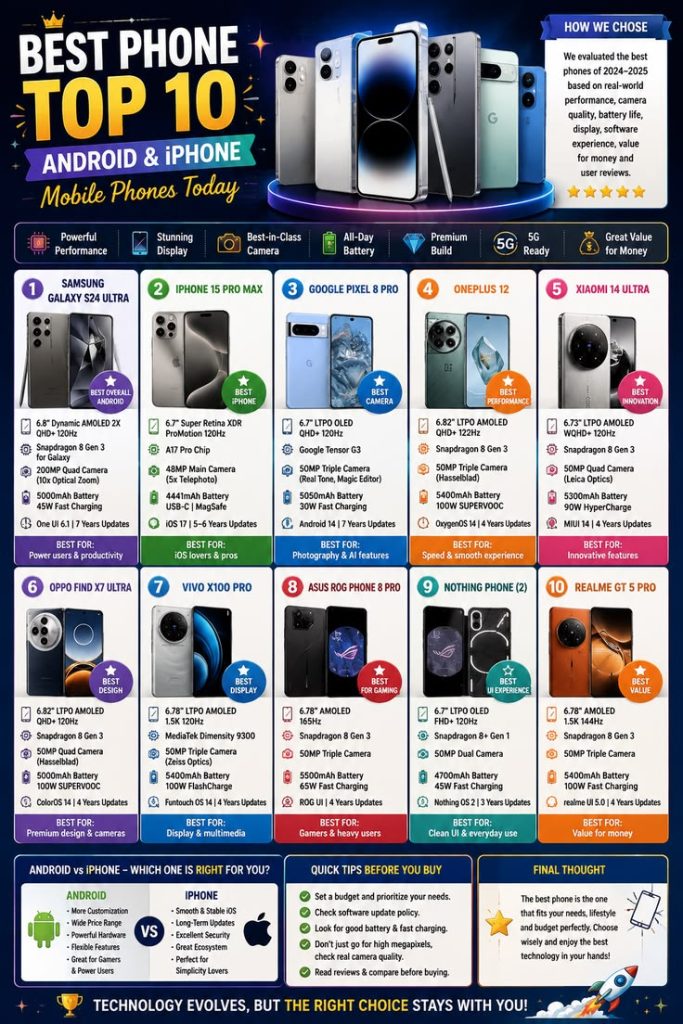
Final Verdict
There’s no single “best” phone for everyone — only the best phone for how you personally use your device. If you want the most complete, dependable experience with no real weaknesses, the Google Pixel 10 Pro XL is our top overall pick. If you’re an Android power user who wants the most advanced AI tools and a built-in stylus, the Samsung Galaxy S26 Ultra is a superb alternative. iPhone loyalists will get outstanding value from the standard iPhone 17, while anyone chasing the best possible camera should seriously consider importing the Oppo Find X9 Ultra.
Don’t feel pressured to spend flagship money, either. The Samsung Galaxy S25 FE and Nothing Phone (3a) both prove that excellent design, strong cameras, and dependable battery life are increasingly available well below the $1,000 mark. And if you’ve been curious about foldables, 2026 is arguably the best year yet to make the jump, with the Motorola Razr Fold and Samsung Galaxy Z Fold 8 both offering genuinely polished, everyday-usable experiences.
Whichever phone you choose from this list, you’re getting a device that’s been rigorously tested against real-world use — not just judged on a spec sheet. Check back regularly, as we’ll continue updating this guide as new phones launch and prices shift throughout the rest of 2026.