
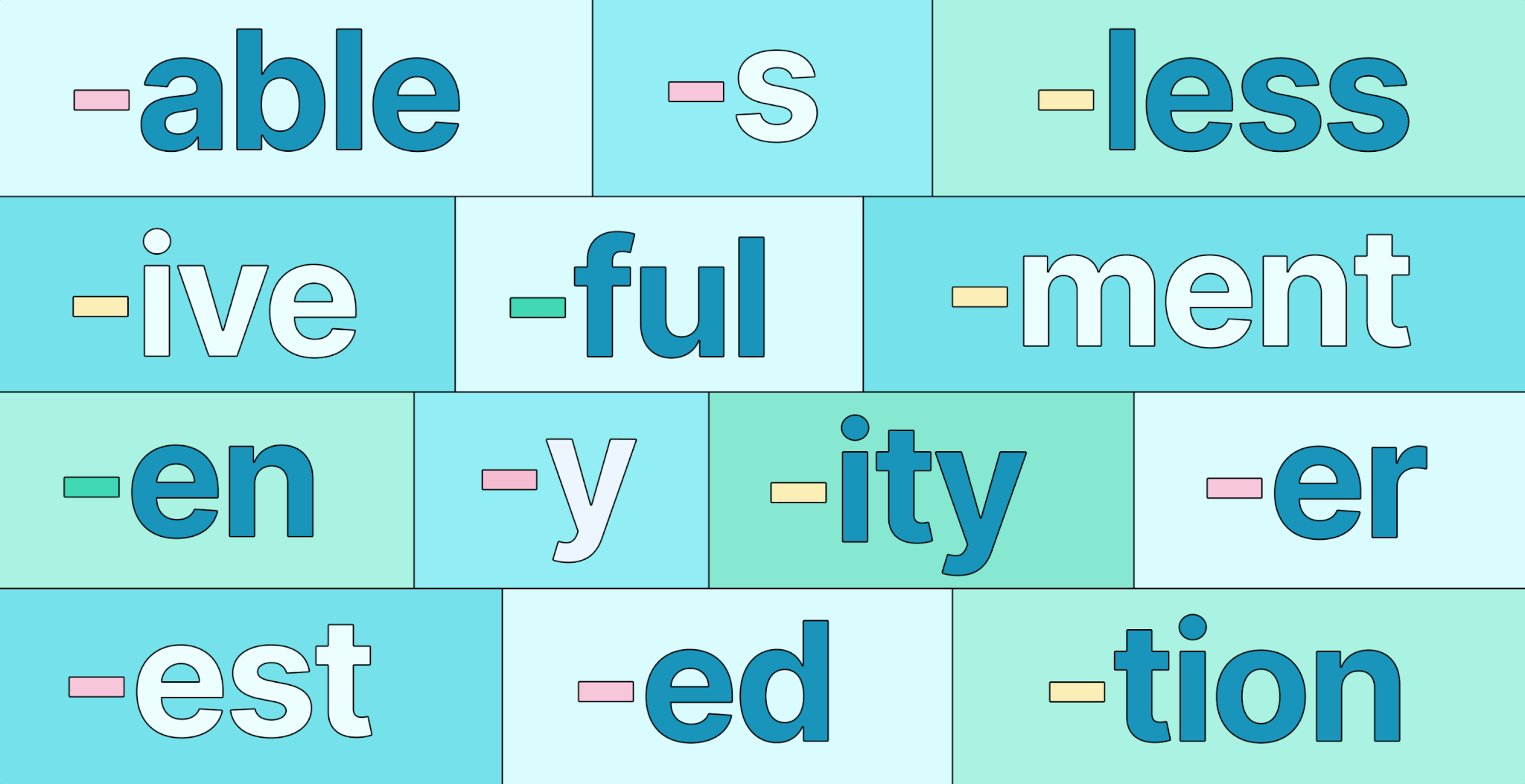
An Overview of Suffixes: The Complete Guide to English Word Endings
There is a particular pleasure, familiar to anyone who has spent real time with language, in watching a small cluster of letters change everything about a word. Take hope. On its own, it is a noun cradling a wish, or a verb reaching toward one. Add -ful and it becomes hopeful, a description of temperament. Add -less instead and the same root collapses into hopeless, despair built from the identical four letters that once carried optimism. Nothing about the root changed. The suffix did all the work.
This is the quiet architecture of English, and suffixes are its load-bearing walls. They rarely draw attention to themselves the way a striking metaphor or an unusual word choice might, yet they determine whether a sentence reads as formal or casual, whether a noun is singular or plural, whether an action happened yesterday or is happening now, and whether a person is described as careful or, through the flip of a single suffix, careless. To understand suffixes properly is to understand something fundamental about how English builds meaning — not by inventing new words from nothing, but by reshaping the words it already has.
This guide walks through what suffixes are, how they differ from prefixes and other affixes, the two major categories that govern how they behave, the specific rules for attaching them correctly, and the vocabulary they unlock across nouns, verbs, adjectives, and adverbs. Along the way, we will look at where these word endings came from, why English spelling sometimes seems to fight against its own logic when suffixes are added, and how a firmer grip on suffixes can sharpen both your reading and your writing.
What Is a Suffix?
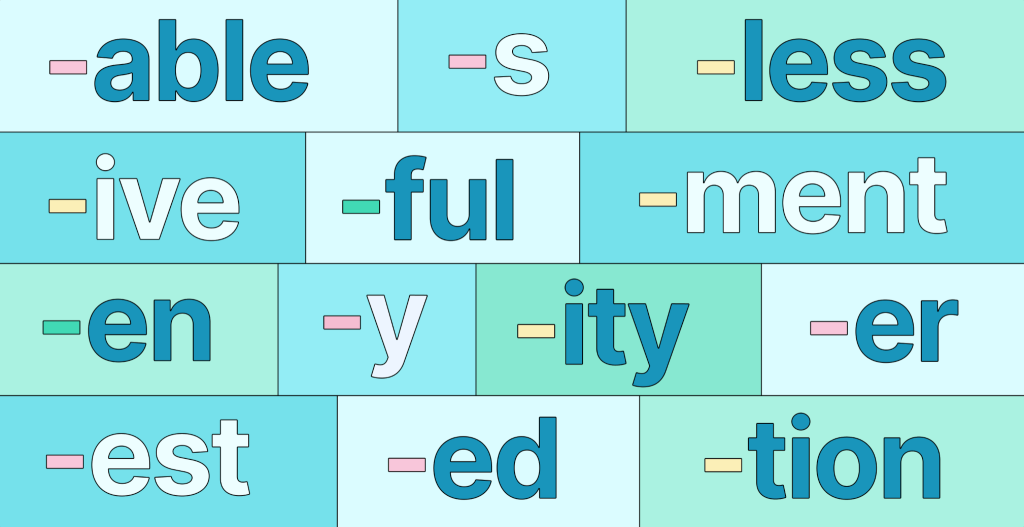
A suffix is a letter or group of letters attached to the end of a base word — also called a root or stem — to alter its meaning, its grammatical function, or both. The addition is never accidental. Every suffix carries its own semantic payload, a small unit of meaning that merges with the root to produce something new.
Consider the adjective quick. Attach -ly, and it becomes quickly, an adverb describing how an action is performed. Consider the noun friend. Attach -ship, and friendship emerges, an abstract noun naming a relationship rather than a person. Consider the verb govern. Attach -ment, and government appears, a noun describing an institution rather than an action. In each case, the root supplies the core idea, and the suffix supplies the grammatical shape that idea takes.
Suffixes belong to a broader linguistic category called affixes, which also includes prefixes (word parts attached to the beginning of a word, such as un- in unstable or re- in rebuild), infixes (rare in English but common in other languages, inserted into the middle of a word), and circumfixes (attached on both sides simultaneously). Affixes, in turn, are a type of morpheme — the smallest unit of language that still carries meaning. A word like unhappiness contains three morphemes: the prefix un-, the root happy, and the suffix -ness. Strip away any one of them, and the meaning shifts or disappears entirely.
It is worth pausing on that distinction between prefix and suffix, since the two are easy to confuse in casual conversation. A prefix sits at the front of a word and typically negates, intensifies, or otherwise modifies the root’s meaning without changing its part of speech — disinfect, antiviral, prerequisite. A suffix sits at the back and is far more likely to change the word’s grammatical category altogether, turning a verb into a noun, an adjective into an adverb, or a noun into an adjective. This positional and functional difference is why linguists treat the two as related but distinct tools in the same toolbox.
Why Suffixes Matter More Than They Seem To
It would be easy to dismiss suffixes as a minor spelling concern — something confined to grammar workbooks and elementary classrooms. That dismissal underestimates them badly. Suffixes are one of the primary mechanisms by which English expands its vocabulary without inventing new roots from scratch. Rather than coining an entirely new word for “the state of being happy,” English simply takes the existing adjective happy and adds -ness, producing happiness. Rather than manufacturing a fresh term for “one who teaches,” it takes the verb teach and adds -er, producing teacher.
This efficiency has a compounding effect. A single root word, dressed in different suffixes, can generate an entire family of related terms spanning multiple parts of speech. The root act, for instance, gives us action (noun), active (adjective), actively (adverb), activate (verb), activation (noun again, but with a different shade of meaning), and activist (a noun describing a person). Learners who grasp how suffixes function do not need to memorize each of these words as an isolated vocabulary item. They can recognize the pattern, decode unfamiliar words on sight, and — just as importantly — construct new words with confidence when the exact term they need does not immediately come to mind.
For writers, this matters on a craft level too. Precision in diction often comes down to choosing the right suffixed form of a word: knowing when to write sensitive versus sensitivity, responsible versus responsibility, create versus creation versus creative versus creatively. Each carries a distinct grammatical role and a distinct rhetorical weight in a sentence, and an ear trained to hear the difference produces cleaner, more exact prose.
The Two Fundamental Categories of Suffixes
Nearly every serious treatment of English morphology divides suffixes into two broad camps: inflectional suffixes and derivational suffixes. The distinction is not academic hair-splitting. It reflects a genuine difference in what the suffix is doing to the word it attaches to, and understanding it clarifies almost everything else about how suffixes behave.
Inflectional Suffixes
An inflectional suffix adjusts a word’s grammatical form without changing its part of speech and, crucially, without creating a new word in the dictionary sense. It simply marks tense, number, comparison, or possession.
English has a remarkably small, closed set of inflectional suffixes — only about eight, depending on how they are counted:
- -s / -es, marking plural nouns (cat → cats, box → boxes) or third-person singular present-tense verbs (run → runs)
- -‘s, marking possession (Maria’s book)
- -ing, marking the present participle or gerund form of a verb (walk → walking)
- -ed, marking the past tense or past participle of regular verbs (walk → walked)
- -en, marking certain irregular past participles (break → broken)
- -er, marking the comparative degree of an adjective or adverb (fast → faster)
- -est, marking the superlative degree (fast → fastest)
Notice what stays constant across each example: the word’s core category never shifts. Walk is a verb before -ing is added, and walking is still functioning as a verb (or a verb-derived noun in gerund use), not a noun proper, an adjective, or an adverb in the way derivational suffixes produce. Fast is an adjective, and faster remains an adjective — simply a comparative version of the same one. Inflectional suffixes are sometimes described by linguists as “closing” morphemes, because they always sit at the very end of a word and no further suffix can be added after them. You cannot, for instance, add another suffix onto cats or walked; the inflection closes the door.
Inflectional suffixes also do not usually alter meaning in any deep sense — dog and dogs refer to the same kind of creature, just in different quantities. Their entire job is grammatical bookkeeping: making sure subjects and verbs agree, making sure plurality is marked, making sure comparisons are properly graded.
Derivational Suffixes
Derivational suffixes are the more dramatic of the two categories. Where an inflectional suffix adjusts, a derivational suffix transforms. Attaching a derivational suffix to a root frequently changes its part of speech entirely, and it almost always shifts or sharpens its meaning.
Take the verb create. Add -ive, and it becomes the adjective creative. Add -ion instead, and it becomes the noun creation. Add -or, and it becomes creator, a noun referring to a person or agent rather than an abstract concept. Three different suffixes, three entirely different grammatical outcomes, all built from the same four-letter root.
Because derivational suffixes generate new dictionary entries — creation and create are listed separately, unlike cats and cat, which share a single entry — they are considered far more productive from a vocabulary-building standpoint. English speakers coin new words through derivation constantly, often informally and without conscious thought: googleable, unfriend, doomscrolling. Each relies on a derivational process, attaching a familiar suffix to a root in order to name something that did not previously have a convenient single-word label.
Derivational suffixes are commonly subdivided further, based on which part of speech they produce:
Noun-forming suffixes turn verbs or adjectives into nouns. Examples include -ness (kind → kindness), -ment (pay → payment), -tion/-sion (inform → information), -ity (equal → equality), -ance/-ence (perform → performance), -hood (child → childhood), -ship (friend → friendship), and -er/-or (teach → teacher, act → actor), which typically names the person or thing performing the action.
Adjective-forming suffixes turn nouns or verbs into adjectives. Examples include -ful (hope → hopeful), -less (hope → hopeless), -able/-ible (read → readable), -ous (danger → dangerous), -ive (create → creative), -al (nature → natural), -ic (history → historic), and -y (noise → noisy).
Verb-forming suffixes turn nouns or adjectives into verbs. Examples include -ize/-ise (modern → modernize), -ify (simple → simplify), and -en (strong → strengthen, short → shorten).
Adverb-forming suffixes turn adjectives into adverbs, most commonly through the addition of -ly (quick → quickly, careful → carefully).
This four-way split is a useful map, but it should not be treated as rigid. A handful of suffixes, notably -er and -ist, produce nouns that name a person (teacher, artist) but can occasionally behave slightly differently depending on the root. Language resists perfectly tidy categorization, and suffixes are no exception — which is part of what makes studying them genuinely interesting rather than merely mechanical.
A Reference List of Common English Suffixes
The following table gathers some of the most frequently encountered suffixes in English, organized loosely by the part of speech they typically produce. This is not exhaustive — English contains dozens of suffixes, many inherited from Latin, Greek, and French — but it covers the ones a careful reader or writer will meet again and again.
Noun-forming suffixes:
- -ness: state or quality of being (kindness, darkness)
- -ment: result or action of (payment, movement)
- -tion / -sion: act, state, or process of (celebration, decision)
- -ity / -ty: quality or condition of (curiosity, loyalty)
- -ance / -ence: state or quality of (importance, confidence)
- -hood: state, condition, or period of (childhood, neighborhood)
- -ship: state, condition, or skill (friendship, leadership)
- -er / -or: one who performs an action (writer, inventor)
- -ist: one who practices or believes in (artist, scientist)
- -ism: doctrine, belief, or practice (optimism, heroism)
Adjective-forming suffixes:
- -ful: full of (joyful, careful)
- -less: without (careless, fearless)
- -able / -ible: capable of being (breakable, visible)
- -ous / -ious: possessing the quality of (dangerous, ambitious)
- -ive: having the nature of (creative, active)
- -al: relating to (natural, cultural)
- -ic / -ical: relating to or characteristic of (historic, economical)
- -y: characterized by (noisy, sleepy)
Verb-forming suffixes:
- -ize / -ise: to make or become (modernize, organize)
- -ify / -fy: to make or cause to become (simplify, clarify)
- -en: to make or become (strengthen, shorten)
Adverb-forming suffixes:
- -ly: in a manner that is (quickly, carefully)
- -ward(s): in a direction (forward, homeward)
- -wise: in a manner or direction (clockwise, likewise)
The Spelling Rules That Govern Adding Suffixes
If suffixes were simply tacked onto roots with no further complication, this section would be unnecessary. In practice, adding a suffix often forces a change to the spelling of the base word, and these changes are among the most common sources of writing errors — even among fluent, well-educated writers. Four rules cover most cases.
The Silent E Rule
When a word ends in a silent -e and the suffix being added begins with a vowel, the -e is typically dropped. Hope becomes hoping, not hopeing. Make becomes making. Believe becomes believable. However, when the suffix begins with a consonant, the silent -e usually stays: hope becomes hopeful, not hopful; state becomes statement, not statment.
There are, inevitably, exceptions. Words ending in -ce or -ge retain the -e even before a vowel suffix, in order to preserve the soft c or g sound — notice becomes noticeable, not noticable, because dropping the e would make the c sound hard. Similarly, courage becomes courageous.
The Doubling Rule
For many one-syllable words ending in a single consonant preceded by a single vowel, that final consonant is doubled before adding a suffix that starts with a vowel. Stop becomes stopped and stopping. Run becomes running. Big becomes bigger. The logic is phonetic: doubling the consonant keeps the preceding vowel sound short, distinguishing hopping (from hop) from hoping (from hope).
This rule extends, with more nuance, to multisyllabic words where the stress falls on the final syllable. Begin becomes beginning, because the stress lands on the second syllable, gin. But offer becomes offering, without doubling the r, because the stress falls on the first syllable, not the second.
The Y-to-I Rule
When a word ends in a consonant followed by -y, the -y typically changes to -i before most suffixes are added. Happy becomes happiness and happily. Beauty becomes beautiful. However, this transformation does not occur before a suffix that itself begins with -i, since English avoids stacking two i‘s together — carry becomes carrying, not carriing.
When the word ends in a vowel followed by -y, the -y is generally retained without change: play becomes playing and played, not plaied.
Words Ending in a Consonant Cluster or Multiple Vowels
Words that end in two consonants, or in a vowel pair followed by a consonant, generally take the suffix without any spelling adjustment at all. Help simply becomes helpful. Read becomes readable. These are, in a sense, the easy cases — no doubling, no dropped letters, no vowel shifts, just straightforward addition.
Mastering these four patterns resolves the overwhelming majority of suffix-related spelling questions a writer will encounter, and recognizing which rule applies to a given word is largely a matter of noticing its final letters and, for multisyllabic words, where the stress falls.
Where English Suffixes Come From
Part of what makes English spelling around suffixes feel inconsistent is that the suffixes themselves were not designed as a unified system. They arrived in waves, borrowed from different language families at different points in history, and each family brought its own conventions along with it.
A substantial portion of English’s native Germanic suffixes — -ness, -hood, -ship, -ful, -less, -ly, -dom — trace back to Old English and the broader Germanic language family. These tend to attach comfortably to native English roots and often carry a plain, direct quality: kindness, childhood, friendship.
A second major layer arrived through Latin, frequently via French after the Norman Conquest of 1066 reshaped English vocabulary dramatically. Suffixes like -tion, -ity, -ment, -able, -ive, and -al belong to this inheritance, and they tend to appear on words with a more formal, Latinate register — information, ability, government, readable, creative, natural. This is why English so often offers pairs of near-synonyms with different registers: the Germanic kingly alongside the Latinate royal, or freedom alongside liberty.
A third layer came from Greek, contributing suffixes such as -ism, -ist, -ize, and -ic, frequently found in the vocabulary of philosophy, science, and the arts — heroism, scientist, modernize, historic.
This layered history explains a great deal about why suffix rules sometimes feel irregular. A word of Germanic origin and a word of Latinate origin might look superficially similar but follow entirely different patterns when a suffix is attached, simply because they entered the language through different routes centuries apart. Recognizing this history will not eliminate every spelling irregularity, but it does explain why the irregularities exist in the first place, which itself takes some of the mystery — and the frustration — out of the matter.
Suffixes Beyond Grammar: Names, Numbers, and Everyday Use
While the grammatical suffixes discussed above make up the bulk of everyday usage, suffixes appear in a handful of other, more specialized contexts worth noting.
Name suffixes distinguish between family members who share an identical name. “Jr.” (Junior) indicates a son named after his father; “Sr.” (Senior) indicates the father; and Roman numerals such as “II,” “III,” and “IV” distinguish further generations. These suffixes exist purely to prevent confusion in legal and social contexts, and they follow none of the spelling or grammatical rules that apply to derivational or inflectional suffixes — they are, in effect, a separate category entirely, closer to a label than a word-formation device.
Ordinal number suffixes turn cardinal numbers into ordinal ones in abbreviated written form: 1st, 2nd, 3rd, 4th. Written out in full, these become first, second, third, fourth — words that, notably, do not use a consistent suffix pattern themselves, since first and second are irregular while fourth onward follows the more predictable -th pattern.
Diminutive and informal suffixes, such as -ie/-y in doggie or movie, or -let in booklet, add a sense of smallness or informality to a root word, and appear frequently in casual speech and in vocabulary aimed at children.
These categories are smaller and less systematically taught than inflectional and derivational suffixes, but a complete overview of the topic would be incomplete without acknowledging that “suffix” as a term stretches beyond strict grammar into naming conventions and informal register as well.
Why Suffixes Are a High-Value Investment for Learners
For students, English language learners, and anyone preparing for standardized examinations, suffixes carry outsized practical value relative to the effort required to learn them. A learner who has internalized a few dozen common suffixes and the rules governing their attachment gains access to thousands of words, because the same suffix behaves predictably across countless different roots. Learning that -tion converts a verb into a noun of action or process unlocks information, celebration, decision, creation, action, and hundreds of others in a single conceptual stroke, rather than requiring each to be memorized independently.
This same pattern recognition supports reading comprehension directly. Encountering an unfamiliar word in a text becomes far less intimidating when a reader can isolate a recognizable root and identify the suffix attached to it, even without knowing the word’s exact dictionary definition. Seeing -less at the end of an unfamiliar word signals “without,” immediately narrowing the range of plausible meanings. Seeing -ology signals “the study of.” This kind of structural decoding is precisely the skill that strong readers rely on when navigating unfamiliar or technical vocabulary, and it is a skill that can be deliberately taught and strengthened rather than left to develop by chance.
For writers, fluency with suffixes supports precision and variety. Rather than repeating the same word form throughout a paragraph, a writer alert to suffix patterns can shift fluidly between decide, decision, decisive, and decisively, choosing whichever grammatical role best serves a given sentence. This is, in miniature, the kind of craft attention that distinguishes prose that merely communicates from prose that reads as considered and precise.
Common Mistakes Worth Watching For
A few suffix-related errors recur often enough to deserve specific mention. Confusing -able and -ible is common, since both suffixes mean roughly the same thing and their distribution is not fully predictable by rule; roots derived from Latin verbs ending in specific patterns tend to favor -ible (visible, credible), while most others favor -able (readable, comfortable), but memorization of frequently used words remains the most reliable strategy.
Confusing -ance and -ence presents a similar challenge, and again no single rule governs the choice perfectly — importance takes -ance while confidence takes -ence, and both must simply be learned as encountered.
Doubling errors are common too, particularly with words like travel, which becomes traveling in American English but travelling in British English, since American and British spelling conventions diverge on when the doubling rule applies to words with stress on the first syllable. Writers working across both conventions should be aware that neither version is “wrong” in isolation — the correct choice depends on which spelling standard the piece is following.
Finally, misapplying the -ly adverb suffix to words that are already adjectives ending in -ly, such as friendly or lovely, produces awkward or nonstandard forms like friendlily, which most style guides recommend avoiding altogether in favor of a rephrased sentence, such as “in a friendly manner.”
Suffixes at Work: A Closer Reading
Abstract rules become far more useful once tested against real sentences, so it is worth slowing down and watching suffixes operate inside actual prose rather than in isolated word lists.
Consider a sentence such as: “Her thoughtful response quickly diffused the tension that had been building since the meeting began.” Nearly every content word in that sentence has been shaped by a suffix. Thoughtful takes the noun thought and, via -ful, turns it into an adjective meaning “full of thought” or “considerate.” Quickly takes the adjective quick and, via -ly, turns it into an adverb describing the manner of the diffusing.
Tension takes the verb tense (or the related root tend) and, via -sion, turns it into an abstract noun. Building takes the verb build and, via the inflectional -ing, marks it as an ongoing process. Meeting similarly takes the verb meet and, via -ing, converts it into a noun naming the gathering itself — a useful reminder that -ing can function both inflectionally, as a present participle, and derivationally, as a noun (sometimes called a gerund), depending on how it is used in context.
That last example is worth dwelling on, because it illustrates something important: the same suffix does not always belong neatly to one category. -ing attached to is building (as in “she is building a house”) behaves inflectionally, simply marking an ongoing action. -ing attached to “the building on the corner” behaves derivationally, since it has produced an entirely new noun with its own dictionary entry, unrelated in immediate sense to the act of construction. Context, not the suffix alone, often determines which role is in play.
A second worked example clarifies how derivational chains can stack. Begin with the adjective sensitive. Add -ity to produce the noun sensitivity. Now consider the negating prefix in-, added to the original adjective to produce insensitive. From there, -ly produces the adverb insensitively, and -ity again produces the noun insensitivity. A single root, combined with one prefix and two different suffixes, generates an entire cluster of related words spanning adjective, adverb, and noun forms, each with a precise grammatical role and each instantly recognizable to a reader who understands how the pieces fit together. This is the practical payoff of suffix literacy: it turns vocabulary from a list to be memorized into a system to be navigated.
A third example demonstrates how suffixes interact with tone and register. Compare “The committee’s decision was final” with “The committee decided finally.” Both sentences describe the same event, but the first, built from noun forms (decision, and the adjective final), reads as more formal and static — appropriate for a report or an official record. The second, built from a finite verb (decided) and an adverb (finally), reads as more immediate and conversational. Skilled writers exploit exactly this kind of suffix-driven flexibility to control the register and rhythm of a piece, shifting between nominal and verbal constructions depending on the effect they want a sentence to produce.
Frequently Raised Questions About Suffixes
Can a word have more than one suffix?
Yes, and this is extremely common in English. A word like carelessness contains the root care, followed by the derivational suffix -less (producing careless), followed by a second derivational suffix, -ness (producing carelessness). Suffixes can also combine with prefixes: unbelievable stacks the prefix un- with the root believe and the suffix -able. There is no strict upper limit on how many affixes a single word can carry, though clarity and pronounceability naturally constrain how far the stacking tends to go in practice.
Is there a difference between a suffix and a word ending?
In casual usage, the two terms are often treated as interchangeable, but technically a “word ending” is a broader, less precise term that can refer to any final letters of a word, whereas a suffix specifically refers to a meaningful morpheme attached to a root. The final letters of cat, for instance, are not a suffix — cat is not built from a smaller root plus an ending — while the final letters of cats are, since -s carries its own grammatical meaning independent of the root.
Do all suffixes change pronunciation as well as spelling?
Many do. Adding -tion to a verb like inform not only changes its spelling to information but shifts where the stress falls in the word, moving it toward the newly added syllable. Adding -ic to history to form historic similarly shifts stress placement. This interaction between suffixation and stress is a well-documented feature of English phonology, particularly for suffixes borrowed from Latin and Greek, and it is one reason unfamiliar suffixed words can sometimes be harder to pronounce correctly on first encounter than their root words alone.
Why do some suffixes seem to have exceptions to every rule?
Because English suffixes were absorbed from multiple source languages across many centuries, as discussed above, no single, unified rulebook governs all of them consistently. A rule that works reliably for a Germanic-origin word may not apply cleanly to a Latinate one, and vice versa. This is less a flaw in the language than a reflection of its layered history, and recognizing that history is often more useful than searching for a single rule to cover every case.
Is it more useful to memorize suffix meanings or suffix spelling rules?
Both matter, but they serve different purposes. Knowing that -ology means “the study of” or that -phobia means “fear of” helps with decoding unfamiliar vocabulary and building new words deliberately, particularly in academic and scientific contexts. Knowing the spelling rules — the silent -e rule, the doubling rule, the y-to-i rule — helps with producing correct, polished writing. A strong grasp of suffixes ultimately requires both: the semantic knowledge of what a suffix contributes to meaning, and the mechanical knowledge of how to attach it correctly.
Bringing It All Together
Suffixes are not a peripheral detail of English grammar, tucked away for spelling tests and then forgotten. They are one of the primary engines by which the language grows, adapts, and expresses precise shades of meaning without needing an endless supply of entirely new words. Every time a verb becomes a noun through the addition of -tion, every time an adjective softens into an adverb through -ly, every time a plain root is dressed in -ness or -ful or -less to carry an entirely different implication, the same underlying system is at work: small, reliable units of meaning attaching themselves to larger ones, reshaping them from the outside in.
Understanding the difference between inflectional suffixes, which merely adjust grammatical form, and derivational suffixes, which transform meaning and part of speech altogether, provides the conceptual foundation for everything else — from correctly spelling hoping versus hopping, to recognizing at a glance what an unfamiliar word likely means, to selecting the precise grammatical form a sentence calls for. Suffixes reward attention. The more closely a reader or writer studies them, the more visible the architecture of the entire language becomes — and the more control that reader or writer gains over it.